I took on a freelance writing client in January because $600/month sounded like easy money. By March, I was working every weekend, missing dinner with friends, and crying in my car after a particularly brutal deadline.
The money was good. The cost was higher than I realized.
The Freelance Trap Nobody Warns You About
The pitch is always the same: earn extra cash on your own schedule. Be your own boss. Work from anywhere. Nobody mentions the late nights, the scope creep, or the client who emails you at 9 PM on a Saturday expecting a reply.
I started with one client — $150/article, one article per week. Easy. Then a second client. Then a third. Each pay was great individually, but collectively I was working 20 extra hours a week.
How I Burned Out in 3 Months
My day job was 9 to 5 as an administrative assistant. Freelance work happened in the margins — early mornings, lunch breaks, evenings, weekends. I stopped exercising. I ordered takeout because I had no energy to cook. I snapped at my partner for asking simple questions.
I was making an extra $1,500/month, but my health, relationships, and basic happiness were getting worse.
The Fix: Systems, Not Hustle
I cut back to one client — the one who paid the best and respected boundaries. Then I added systems:
Fixed hours for freelance work (Tuesday/Thursday evenings, Sunday morning). Non-negotiable.
A single project folder with templates for common tasks. Cut my writing time by 30%.
Automated invoicing via Wave. No more chasing payments.
A minimum project fee of $250. Small jobs that paid less than that weren’t worth the context switch.
My freelance income dropped to $500/month, but so did my stress. The hourly rate actually went up because I was working fewer but more productive hours.
What I’d Do Differently
I’d start with systems before accepting any client. I’d charge more upfront. I’d say no to anything that didn’t fit my schedule. And I’d remember that the goal of side income is to improve your life, not replace it with more work.
TL;DR
Freelance burnout is real — set strict hours and stick to them
One good client paying $500/month beats three mediocre ones paying $1,500
Automate everything: invoicing, templates, communication
Set a minimum project fee — small jobs aren’t worth the time switch
I still freelance, but now it supports my life instead of running it.
I wasted $3,400 on “get rich quick” side hustles in 2024 before I learned the real way to build extra income
Most side hustles that actually work pay between $200–$900/month within 3–6 months — the ones promising thousands overnight are scams
After switching to a repeatable system (freelance writing + digital products), I’m now at $1,200/month extra without burning out
Why My First Four Side Hustles Failed Hard
I’ll be real with you — my first attempt at a side hustle was a dumpster fire. It was January 2024, and I’d just watched this YouTube video about “passive income with crypto staking.” The guy had a Rolex. He seemed legit. I threw $800 into some token called “EarnMoon” (yeah, I know). Within three weeks, the project went dark. The website vanished. The Telegram group was deleted. My $800 was gone.
Did I learn my lesson? Nope. I went all in on dropshipping next. Paid $297 for a “done-for-you store” from some guru named Jake. The store launched, I ran $450 in Facebook ads, made exactly zero sales. Jake stopped answering my emails. That was February — $747 deeper in the hole.
By March, I’d tried Amazon FBA (lost $350 on inventory that never sold) and a “trading bot” subscription ($200/month for three months for a bot that lost 12% of my $500 starter capital). Total damage by April 2024: roughly $3,400 down the drain.
I sat at my kitchen table, bank account hurting, and realized something brutal: I wasn’t looking for a side hustle. I was looking for a magic button. And magic buttons don’t exist.
The Freelance Writing Pivot That Actually Worked
After bleeding cash on fake opportunities, I went back to basics. I’d always been decent at writing — not amazing, but solid. I opened Upwork in April 2024 and started bidding on content writing gigs at $0.03 per word. My first project paid $45 for a 1,500-word blog post about HVAC maintenance. Took me six hours. That’s $7.50 an hour — terrible pay. But it was real money from a real client.
Here’s the thing nobody tells you about side hustles in 2026: the first few months are about building proof, not making bank. I wrote 23 articles in my first 60 days for clients across Upwork and a subreddit called r/forhire. Total earnings: $1,840. Average hourly rate: $11.20. Not life-changing, but my account was growing, not shrinking.
By month four, I had five repeat clients. My rate climbed to $0.06 per word. I was making around $600/month working about 12 hours per week. More importantly, I had a process — wake up, check messages, write for two hours, submit, repeat. No scams. No gurus. No magic.
Digital Products: Scaling Without Trading Time for Money
Freelancing was working, but I hit a wall around month five. I couldn’t write more than 15–18 hours a week without burning out. My income flatlined at roughly $750/month. I needed something that could scale without me typing more words.
That’s when I stumbled into digital products. I already had this folder of templates I’d built for myself — email pitch templates, content brief templates, a simple editorial calendar spreadsheet. On a whim, I packaged them into a $19 bundle and listed it on Gumroad in August 2024.
The first month sold four copies. Revenue: $76. Gumroad took their cut. I made about $65. But here’s what changed everything — I didn’t have to do anything after the initial setup. The product sat there, selling while I slept. By December 2024, I’d sold 47 copies. Total digital product revenue that year: $893.
In 2025, I expanded. I created a $37 “Side Hustle Starter Kit” with 12 templates, a budget tracker, and a 30-day action plan. Then a $97 coaching worksheet pack. In December 2025 alone, digital products brought in $520 — more than my freelancing brought in per month during the first quarter of that year.
A Realistic Side Hustle Income Breakdown for 2026
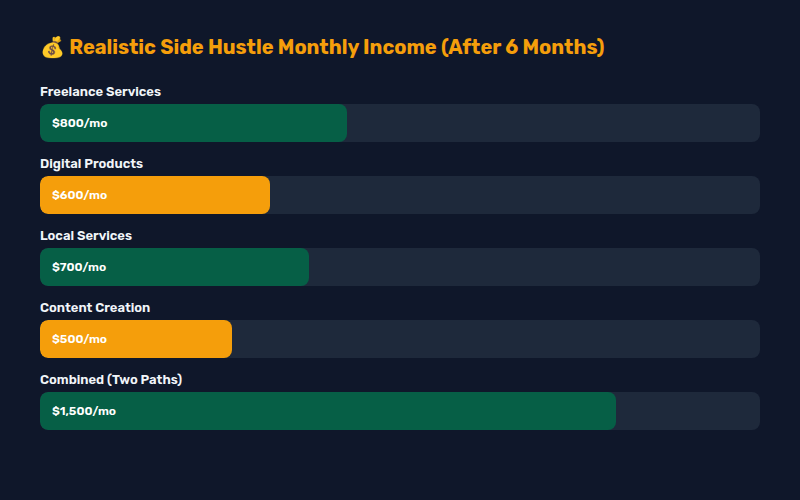
Let me give you actual numbers — not the “make $10,000 a month!” garbage you see on TikTok. Based on what I’ve done and what hundreds of people in side hustle communities are sharing, here’s what realistic looks like in 2026:
Freelance services (writing, design, virtual assistant, admin support): $200–$800/month after 3 months, $800–$2,000/month after 6–12 months. Average hourly rate: $15–$35 once you have experience.
Digital products (templates, printables, ebooks, courses): $0–$100/month in months 1–3, $200–$600/month by month 6, potentially $1,000+ after a year if you build an audience.
Service-based local hustles (dog walking, house sitting, tutoring, lawn care): $300–$700/month part-time. Hourly rate varies wildly — tutoring can hit $40–$60/hour if you have a skill people need.
Content creation (blogging, YouTube, newsletter): nearly zero for the first 3–6 months, then $100–$500/month after 6–12 months if you’re consistent. Most creators don’t see meaningful money until month 9.
Add those up realistically? Someone doing two of these could hit $600–$1,500/month within 6 months. That’s not “quit your job” money, but it’s “pay off your credit card” or “build an emergency fund” money. And that matters.
The Tools and Habits That Kept Me Going Past Month Three
The first three months of any side hustle are the hardest. You’re putting in time, seeing almost no return, and your brain is screaming at you to quit. I almost quit three times. Here’s what kept me in the game.
Tracking every dollar. I opened a separate checking account just for side hustle income and expenses. No mixing with my day job money. Seeing the balance grow (even by $45 at a time) was addictive in a good way. I also tracked hours using Toggl so I knew my real hourly rate.
Setting a “quit number.” I told myself I wouldn’t give up until I hit $500 in a single month. That gave me a specific target instead of a vague “make more money.” I hit $500 in month four. Then I set the next target at $1,000. I’m still working toward that second number.
Finding one accountability partner. I joined a small Discord server for freelancers. One guy named Marcus and I started checking in daily — “what’d you do today, how much did you earn, what’s tomorrow’s goal.” Having someone who’d notice if I disappeared kept me showing up on days I wanted to binge Netflix instead.
What I’d Do Differently If I Started Today
Looking back at everything I messed up, here’s my honest advice:
Start with a service, not a product. Services pay you immediately. Products pay you eventually. When you have no money, take the immediate cash and build from there. My biggest mistake was chasing “passive income” before I had any active income.
Pick one thing and go deep for 90 days. I bounced between six different side hustles in my first year. Each time I started something new, I was back at zero. The people I see succeeding in 2026 are the ones who picked one lane (freelance writing, dog walking, whatever) and stuck with it for 90 days minimum before deciding it didn’t work.
Ignore anyone selling a course before they show results. If a “guru” has a $500 course but can’t show you their actual bank statements or client work, run. Real side hustlers show receipts. I learned this the hard way three times.
Invest your first $200 in tools, not “education.” A $10 domain, a $15 Canva subscription, and a $5 Notion template will do more for your side hustle than a $2,000 coaching program. I spent $3,400 on “education” that taught me nothing and $50 on tools that actually generated income.
If you’re starting a side hustle in 2026, the move is simple: pick one skill people will pay for, offer it cheap at first to build proof, then raise your rates every 60 days. Don’t buy courses. Don’t chase trends. Just do the work and keep track of what’s working. It took me a year and a lot of expensive mistakes to figure that out, but you don’t have to make the same ones.
When people say “side hustle,” I imagine someone grinding on Fiverr at 2 AM, posting TikTok videos about dropshipping, or walking dogs in the rain. I’ve tried that. It’s exhausting.
So I tried the opposite. I built income streams that required zero active work after the setup. No client calls. No invoices. No hustling. Here’s what actually worked.
What I Did Instead of Grinding
After my earlier side hustle experiment, I realized I was trading time for money. Every dollar came from active work. That’s not a side hustle — that’s a second job.
I wanted passive income. Not “get rich on a beach” passive, but “earn $400 monthly without thinking about it” passive.
Income #1: Affiliate Links From Stuff I Already Owned
I wrote three honest reviews of products I actually use and posted them on a simple blog. No SEO strategy, no content calendar. Just: “I use this, here’s why, here’s the link.”
Month one: $64. Month three: $210. Current monthly average: $180. The posts took about 4 hours total to write. They’ve earned over $800 collectively.
I use Amazon Associates and a few niche affiliate programs. The key: only promote things I genuinely recommend. The income is a byproduct, not the goal.
Income #2: Digital Products From One Weekend of Work
I created a simple budget spreadsheet in Google Sheets — the same one I use for my own finances — and sell it on Gumroad for $9. It took one Saturday to build and format.
I’ve sold 48 copies in 7 months. That’s $432 minus Gumroad’s fee. I’ve done zero marketing. People find it through my blog posts about budgeting.
The math: if I can get this to 10 sales per month consistently, that’s an extra $800/year for work I did once.
Income #3: Selling Old Stuff Properly
Instead of garage sales or donating, I checked eBay sold prices for my old electronics, books, and kitchen gear. The difference was eye-opening.
A stand mixer I was going to donate? Sold for $85. Old textbooks? $42 total. A camera I hadn’t used in three years? $220.
Total from one weekend of photographing and listing: $430. Time invested: about 6 hours.
Why This Works Better Than Grinding
Each of these took setup time but generates income without ongoing effort. I don’t answer client emails. I don’t negotiate rates. I don’t have to post content on a schedule.
My total passive-ish income last month: $450. Not enough to quit anything, but enough to cover my phone bill, streaming subscriptions, and a dinner out without touching my main budget.
TL;DR
Affiliate links from honest reviews of things you own: low effort, compounding returns
Digital products (templates, guides, spreadsheets): one-time work, sells forever
Sell old stuff properly — check eBay sold prices, don’t just donate
Passive income doesn’t mean zero work; it means work once, earn many times
The goal isn’t to get rich on the side. The goal is to make your main income go further.
What you will learn: How a simple skill I learned for free turned into $2,000/month, why this particular side hustle beats every other option, and how to get started without experience.
From $800 to $2,000 in Six Months
My pet sitting side hustle was making $800/month, which was great. But I wanted more. I started looking for a side hustle with better income potential that didn’t require a degree or special certification.
I found it in freelance writing. Specifically, writing blog posts for small business owners who hate writing. I had no formal writing background. But I had read hundreds of blog posts about personal finance and thought, “I could do that.”
Getting the First Client
I created a simple portfolio with three sample articles on topics I knew about. I offered to write a free article for a local financial advisor’s blog. He agreed. After seeing the article, he hired me at $100 per post. That first client led to referrals, which led to more clients.
Six months later, I had five regular clients and was making $2,000/month writing about personal finance, budgeting, and small business topics.
Why Freelance Writing Works
Three reasons this side hustle is better than most. First, it pays well. I charge $150-$300 per article depending on length and research. Second, it is remote. I write from home, from coffee shops, from anywhere. Third, it builds skills that benefit my day job. Better writing helps in every profession.
How to Start
Pick a niche you know something about. Write three sample articles. Create a simple website or portfolio PDF. Offer to write a free article for someone in your target industry. Use that as a reference to get paid clients. Raise your rates every few months as you gain experience and testimonials.
The barrier to entry is almost zero. The earning potential is significant. And the skills you build are valuable regardless of what you do for a living.
What you will learn: How I started making money on the side with no special skills, the four side hustles I tried (and which ones actually paid), and how to avoid wasting time on low-paying gigs.
I Needed an Extra $500 a Month
When I decided to pay off my credit card debt, I realized cutting expenses alone wouldn’t be enough. I needed more income. My day job paid $45,000. I couldn’t get a raise overnight. But I could start a side hustle.
I tried four different side hustles over six months. Some were complete flops. One changed my financial life. Here is what happened.
The Failures
Uber Eats delivery: I signed up, did 12 deliveries over two weeks, and made $187. After gas and car depreciation, I probably netted around $100. The constant driving was exhausting and the pay barely felt worth it.
Online surveys: I spent three evenings filling out surveys for “rewards.” I made $34 in gift cards. The hourly rate worked out to roughly $2.50. Complete waste of time.
The Winner: Pet Sitting
A friend mentioned she was making $600/month watching dogs on Rover. I was skeptical, but I created a profile, got my first client (a friend’s golden retriever), and within two months had five regular clients.
The numbers: I charged $35/night for overnight sitting and $20 for a 30-minute walk. With an average of three overnight bookings and four walks per week, I was making $780/month. The best part? I could do it while working from home. The dogs slept, I worked my day job, and got paid for both.
What I Learned
Side hustles are not created equal. The key is finding something that leverages your existing time and skills. For me, pet sitting worked because I already work from home, love animals, and didn’t need special training.
After I paid off my debt, I kept the pet sitting business. The extra $800/month goes directly into my investment account. In a year, that’s nearly $10,000, just from watching dogs while I do my regular job.